
Best Practices for Teaching RMI Professionals
Best Practices for Effective RMI Instruction
Gifted RMI professionals often find themselves in teaching roles—whether leading training sessions, mentoring colleagues, or presenting to clients. The following principles of adult education are designed to support and enhance that instruction, offering strategies that make learning more engaging, applicable, and effective. The content is organized around 10 key principles:
Reinforcing Relevance: Emphasizing real-world applications of learning. Once the objective is set, you help learners understand why it's important—connecting the content to real-world roles.
Activating Prior Knowledge: Drawing on learners’ professional experiences. Before diving into new material, effective instructors tap into what learners already know.
Promoting Active Learning: Incorporating experiential activities to foster engagement. With the problem established, active learning becomes the method for exploring and resolving it.
Designing Purpose-Driven Objectives: Aligning instruction with workplace outcomes. Effective instruction begins with knowing what the learner should achieve. This anchors all other decisions.
Focusing on Problem-Solving: Centering instruction on real-world challenges by contextualizing the need. Adult learners engage best when solving real challenges—so frame the “what” with the “why now.”
Using Storytelling: Making the learning stick with relatable narratives that illustrate application. Storytelling can deepen engagement, especially when paired with active learning or case scenarios.
Chunking Content: Managing complexity by structuring material into digestible, progressive segments. As content is delivered, chunking makes it more digestible and easier to scaffold for deeper understanding.
Progressing Through Bloom’s Taxonomy: Deepening learning by guiding learners toward higher-order thinking. Advancing instruction into more complex cognitive tasks is essential for achieving mastery, and Bloom’s provides a deliberate framework for building that complexity in ways that strengthen understanding and support meaningful application.
Encouraging Reflection: Consolidating understanding by incorporating opportunities for critical self-analysis. Structured reflection ensures learners process what they’ve learned and connect it to practice.
Fostering Collaboration: Extending learning by building community and peer-to-peer learning. Collaboration not only reinforces knowledge but also invites new perspectives, solidifying learning through peer exchange.
Each principle offers practical ways to elevate instructional impact, whether in a classroom, a boardroom, or a virtual learning space. While each stand on its own, there is meaningful overlap among them; together, they form a flexible and interwoven foundation for creating learning experiences that resonate with adult learners and drive real-world outcomes across the RMI field.
RMI professionals need to know why they’re learning something, and better yet, how it relates to the work they do.
Framing Instruction
Professionals in risk management and insurance benefit most when instruction is pragmatic, significant, and relevant to their position.
For instance, an RMI instructor may begin their session with something like,
“Today, we'll explore the latest advancements in property risk assessment tools. By the end of this session, you'll be able to understand the new features of these tools, how they provide more accurate risk evaluations, and the way they can streamline your daily operations in property insurance."
Instructors may even double down on the real-world practicality of their instruction:
“As property insurance professionals, your goal is to accurately assess risks to provide the best coverage for your clients. These advanced tools are not just theoretical concepts; they're practical solutions that you can use to enhance your risk assessments, reduce claim times, and offer better policy options."
-
To keep instruction relevant and actionable throughout the session, RMI instructors should reinforce key takeaways using practical, role-specific strategies. This can be achieved with a variety of methods and modalities, including:
Case studies, such as analyzing a house fire to show how risk assessment tools could have identified potential risks more effectively.
Interactive demonstrations and modeling, where learners engage with the new tools as the instructor highlights their relevance to specific roles and responsibilities.
Frequent emphasis on and summaries of key points, revisiting how the tools enhance precision and efficiency in risk assessment while linking these benefits to learners’ daily tasks. This repetition helps reinforce the practical significance of the material and ensures it remains front-of-mind for participants as the session progresses.
Direct calls to action, such as prompting RMI professionals to identify one area of their risk assessment process that these tools could improve.
-
Effective instruction goes beyond delivering information; it frames content in ways that align with the real-world needs of RMI professionals. The difference between good and better instruction often lies in how clearly material connects to practical application. For example:
Good instruction: Providing an introduction to the RMI industry.
Better instruction: Demonstrating how risk exposure can be best explained to a client.
-
In addition to emphasizing practicality, strong instruction reflects the specific roles and responsibilities of learners. For instance:
Good instruction: Exploring professional skills needed in the RMI industry.
Better instruction: Showing how claims adjusters can improve loss assessment form completion rates.
These distinctions illustrate the difference between theoretical knowledge and actionable insights. When instructors focus on the latter, they empower RMI professionals to enhance their client interactions and operational outcomes.
RMI professionals bring a wealth of knowledge and experience to their learning environment, and they are most motivated when they feel seen, respected, and valued.
Activating Prior Knowledge
Instruction is most effective when it actively draws on learners’ existing knowledge and professional experience. Skilled instructors do this by engaging RMI professionals’ prior knowledge—either explicitly through structured activities like pretests, quizzes, and self-reflection exercises (e.g., “Write the first three words that come to mind when you hear the word reinsurance.”) or implicitly through rhetorical strategies that resonate with learners' shared experiences.
-
One effective way to engage learners’ prior knowledge is by opening with a grounding statement that reflects shared professional realities.
For example:
"Risk management and insurance is a field where change is constant, and even the most experienced professionals face evolving challenges. For example, consider the dynamics of underwriting in the context of emerging risks like cyber liability or climate-related exposures. Today, we’ll focus on how foundational principles can be adapted to navigate these complexities effectively and enhance your decision-making—whether it’s structuring policies, advising clients, or managing claims."
This approach acknowledges shared professional experiences while setting the stage for practical, targeted instruction. By framing the material around a common experience, it immediately connects the content to learners' professional realities and demonstrates respect for their expertise.
-
To effectively bring prior knowledge into the learning process, instructors can employ several methods, including:
Anchoring content in shared experiences: For example, starting with “Many of you have likely faced the challenge of analyzing a renewal proposal under tight deadlines. How do you approach prioritizing risks and assessing coverage gaps in such situations?” This invites learners to connect the content to a shared, situational experience that is common in their professional environment.
Encouraging reflection: Through short exercises such as “Identify one instance where a miscommunication about policy terms led to complications and describe how the situation was resolved.” This encourages deeper individual reflection about a personal or specific professional scenario, distinguishing it from shared group experiences.
Tying instruction to practical, role-specific contexts: For example, “Imagine you are preparing a presentation for a prospective client who operates in a high-risk industry, such as construction. Your task is to explain how reinsurance supports the insurer’s ability to offer tailored coverage without overexposing the company to risk. What key points would you highlight, and how would you adapt your explanation to their industry-specific needs?” This scenario directly links the instructional content to a practical, role-specific task (client presentations) while tailoring it to a realistic professional challenge learners might encounter.
-
By situating learning in such relevant and relatable contexts, instructors can foster a deeper engagement with the material. However, to truly capitalize on this engagement, it is equally important to differentiate between superficial acknowledgment of learners’ participation and meaningful activation of their expertise and experience:
Generic acknowledgment: Recognizing the number of webinar attendees: “We have 50 participants joining us today, which is fantastic!”
Meaningful activation: Framing the session by acknowledging a shared professional challenge, such as, “Many of you have experienced the intricacies of explaining reinsurance agreements to clients—let’s focus on simplifying those conversations using actionable strategies.”
Meaningful activation resonates more deeply because it validates learners’ expertise and ties the content to their lived experiences.
-
While shared professional experiences and challenges can unify learners, it is equally important to acknowledge the wide range of individual backgrounds and perspectives within the RMI industry. Acknowledging this diversity ensures that instructional content resonates not only with the collective professional context but also with individual realities. RMI instructors should aim to create a learning environment where all participants feel their unique backgrounds are respected and their contributions are valued.
To achieve this, RMI instructors can employ strategies that recognize and celebrate diversity while still addressing universal themes. This dual focus not only validates individual experiences but also enriches the learning environment by fostering an inclusive and comprehensive approach to instruction.
Some examples:
Providing illustrative examples that reflect not only the community they serve but also the broader spectrum of demographics, such as race and ethnicity, socio-economic status, and geographic location.
Incorporating scenarios that allow learners to see their own professional contexts represented in the instruction. For example, an exercise might involve analyzing a case study from a geographically distant region or a sector learners are less familiar with, prompting them to draw parallels and contrasts with their own experiences.
Designing group activities that encourage collaboration among participants with diverse perspectives and experiences. For instance, a workshop might assign learners to mixed teams representing different roles within the RMI industry (e.g., underwriters, claims adjusters, brokers) to solve a complex problem, such as developing a risk management strategy for an emerging market. This approach allows participants to learn from one another’s expertise while fostering a deeper understanding of how diverse perspectives contribute to problem-solving and decision-making.
-
Among the many dimensions of diversity, generational diversity is one of the easier types to acknowledge in RMI professionals. This is largely because society has established firm definitions of generational groups, and educational research has identified and prescribed distinct learning preferences for each. However, it is important to note that generational diversity is not necessarily the most critical aspect of diversity to address. It is highlighted here because it offers a useful framework for understanding broad trends in learning preferences and can help RMI instructors create more tailored and effective instruction.
The following offers general guidance on the learning preferences of generational subgroups, though these should be treated as broad generalizations rather than definitive rules of engagement:
Baby Boomers: Baby Boomers prefer instructors to be approachable experts (Lynch, 2015). They are accustomed to lecture-based instruction, as long as it incorporates dynamic elements like participation, reflection, and feedback (Panopto, 2017). This generation tends to be comfortable with theory and confident in their ability to apply theoretical concepts in practice.
Gen X-ers: Gen X-ers value instructors who act as guides, enabling them to discover outcomes and solutions after being introduced to scenarios, challenges, and tools (Lynch, 2015). While they appreciate some lecture, they prefer workshops and seminars, especially those focused on case studies (SeamsCloud, n.d.). This generation expects instruction to be explicitly framed as relevant to their work and professional challenges (Wiley University Services, 2022).
Millennials: Millennials see instructors as collaborative guides, viewing themselves as co-creators of learning opportunities (Lynch, 2015). Having grown up with easy access to information online, they prefer instruction that contextualizes facts, emphasizes relevance, and offers opportunities for application. Millennials thrive in environments that encourage consistent engagement and incorporate technology into the learning process (Wiley University Services, 2022).
Gen Z-ers: Gen Z learners see instructors as partners focused on building practical skills. Like Millennials, they understand that facts are readily available, but they prioritize learning experiences that are relevant, applicable, and career-focused. This generation favors active learning opportunities and content designed to directly support career advancement (Yob, 2023).
Of course, RMI professionals are rarely grouped by generation for learning purposes, although instruction targeted at specific job levels (e.g., entry-level, mid-level) may indirectly align with generational cohorts. Nonetheless, generational trends still provide useful context for understanding potential differences in learning preferences. More importantly, they highlight the need for diverse instructional approaches that address the varied knowledge, experiences, and learning styles of RMI professionals, even within a single session.
In unifying the acknowledgment of shared professional experiences with the recognition of individual learner diversity, and tailoring examples to diverse needs, RMI instructors can foster meaningful connections between existing expertise and new content. This dual approach not only deepens understanding but also enhances learners’ confidence in applying what they’ve learned to their professional responsibilities.
RMI professionals excel when learning is experiential and directly applicable.
Promoting Active, Experiential Learning
They thrive on instruction that not only explains but also provides opportunities for learners to actively apply their knowledge. This approach not only reinforces theoretical concepts but also builds confidence in tackling real-world challenges.
Consider the difference between passive and active learning:
Good Instruction: Learners hear about the role of a data analyst in RMI.
Better Instruction: Learners analyze sample datasets, uncovering insights and mirroring the responsibilities of a data analyst.
In this example, the "good instruction" approach represents passive learning, where learners absorb information but do not directly engage with it. By contrast, the "better instruction" approach exemplifies active learning, where learners interact with the material through analysis and application. This shift from passive to active engagement transforms theoretical knowledge into practical understanding and skill development.
Similarly, role-playing scenarios offer a controlled, risk-free environment for learners to apply new concepts. An instructor might, for instance, guide participants through applying a risk assessment framework to a hypothetical construction project. This immersive approach allows learners to practice problem-solving and decision-making in situations closely aligned with their professional contexts.
-
When logistical, regulatory, or other constraints make hands-on experiences impractical, instructors can leverage facilitated examples and modeling techniques to bridge the gap. These methods can still make theoretical concepts resonate by showing their practical relevance and application.
By thoughtfully presenting and breaking down relevant cases or scenarios, instructors can make the material resonate and ensure its relevance to learners’ professional roles. For example:
Good Instruction: Learners are introduced to a high-profile liability case in the construction industry and review its key points.
Better Instruction: The instructor models the process of analyzing the case by walking learners through each step—evaluating the failed risk assessment with relevant documents, discussing the resulting legal and financial repercussions, and exploring how alternative strategies could have mitigated the outcome. By observing this demonstration, learners gain a first-hand understanding of how they could replicate the analytical process step by step in their own projects—examining relevant documents, identifying gaps in risk assessments, and making informed decisions to mitigate potential liabilities.
-
To enhance the effectiveness of any learning method, RMI instructors should aim to design instruction that aligns with established frameworks such as the Kirkpatrick Evaluative Model (see Figure 1).
While Levels 3 and 4 (behavior change and organizational impact) may be challenging for contracted educators to assess, impactful learning can still be achieved through the first two levels:
Level 1 – Reaction: Solicit learner feedback to evaluate the relevance, engagement, and clarity of the instruction.
Level 2 – Learning: Incorporate knowledge checks, case studies, or application exercises to gauge learners’ understanding and ability to apply new concepts.
By prioritizing hands-on experiences wherever possible and leveraging demonstrations or detailed examples when necessary, RMI instructors can ensure their content is both engaging and practical. This structured approach empowers professionals to transform theoretical knowledge into actionable insights, enhancing both individual and organizational performance.
Figure 1
Kirkpatrick’s Four Levels of Evaluation
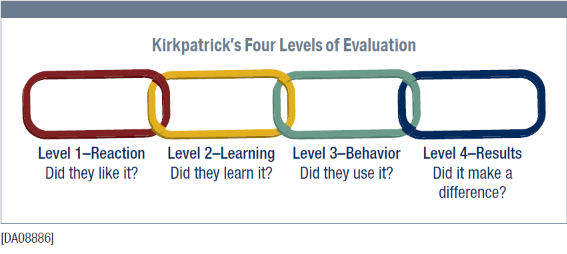
Note. From Train the Trainer, by the American Institute for Chartered Property Casualty Underwriters, 2021, p. 6.13.
RMI professionals are driven by purposeful learning.
Aligning Learning With Workplace Outcomes
RMI professionals approach learning with a clear focus on tangible goals. For them, education is a practical tool to bridge skill gaps, achieve professional milestones, or advance personal aspirations. This results-driven mindset drives them to seek training that directly impacts their career growth, workplace effectiveness, and professional visibility—often reflected in showcasing performance-aimed skills on platforms like LinkedIn.
Successful RMI educators recognize this and align their teaching strategies to support workplace outcomes. The sections on the right highlight five practical ways they do that.
-
Effective learning objectives go beyond abstract goals, offering learners a direct link between instruction and professional practice. They provide a clear roadmap for what learners will achieve and emphasize practical outcomes rather than theoretical understanding.
Good instruction: "By the end of this course, you will understand the principles of risk assessment for commercial properties."
Better instruction: “By the end of this course, you will be able to use XYZ software to evaluate commercial property risks, identify key vulnerabilities, and create actionable mitigation strategies tailored to client needs."
The “better instruction” example ensures learners can immediately see how their new knowledge translates into real-world skills they can apply directly to their roles. The objective:
Clearly outlines what learners will be able to do (evaluate risks, identify vulnerabilities, create strategies);
Emphasizes the use of a tool (XYZ software) that is relevant to the industry, ensuring learners see the immediate applicability of their new skills;
Aligns with professional advancement by focusing on deliverables valued by employers, such as tailored client solutions and operational efficiency.
Some instructors go a step further by tailoring their objectives to match job responsibilities and performance measures commonly identified on third-party sites like Indeed or LinkedIn. For example, they may emphasize learning advanced claims management techniques sought after by employers, such as AI-powered fraud detection or process automation tools to speed up claims processing. This alignment reinforces the connection between mastering identified skills and improving job performance, marketability, and career growth.
-
As noted earlier, RMI professionals thrive when instruction is focused and pragmatic. To that end, each session or module should prioritize and explicitly identify skills that translate into workplace value.
For example, a session on risk modeling could break down into distinct chunks:
Mastering the technical aspects of using a new risk evaluation software.
Applying the software to real-world scenarios, such as assessing flood risks for residential properties.
Developing client-ready reports based on software-generated insights, tailored to industry standards.
Each chunk builds toward the ultimate goal of equipping learners with the practical expertise needed to excel in their roles and demonstrate performance-oriented outcomes.
-
RMI professionals engage best with material that mirrors the challenges and opportunities they encounter on the job. Instructors can use techniques like the following to ensure their teaching resonates:
Analyze a real-life scenario where inadequate risk assessment led to significant client losses. They could then identify where better tools or methods could have improved outcomes.
Work with mock client data to create a risk profile, make recommendations, and present findings using industry-standard tools, simulating professional tasks.
By grounding instruction in realistic challenges, educators help learners draw clear connections between training and day-to-day responsibilities.
-
Highlighting practical applications at every stage ensures learners stay connected to the material. Instructors can use techniques like the following to reinforce relevance and encourage engagement:
Emphasize how key concepts and strategies directly contribute to organizational success and client satisfaction (e.g., accurate claims adjustment reduces costs, enhances client satisfaction, and improves efficiency).
Encourage learners to apply new knowledge to real or hypothetical workplace challenges, promoting practical integration into their roles (e.g., identify a workplace problem and outline solutions using newly acquired skills or tools).
-
RMI professionals value instruction that supports both immediate job performance and long-term growth. Effective teaching bridges technical know-how with strategies for professional advancement. For instance:
Good instruction: Explaining basic underwriting principles.
Better instruction: Sharing techniques for creating underwriting proposals that gain client trust and align with organizational priorities.
This matters because career relevance is often the lens through which RMI professionals judge training value. By aligning learning to both operational and aspirational goals, educators help RMI professionals connect their training to meaningful career outcomes. Reinforcing the career implications of newly acquired skills—such as how they enhance job performance and marketability—ensures that learners see education not as an abstract exercise but as a direct pathway to professional success.
RMI professionals are problem-focused learners.
Aligning Instruction With Everyday Professional Challenges
RMI professionals engage most effectively with instruction that addresses real-world challenges they encounter and offers straightforward, easy-to-implement solutions. Problem-centered instruction reinforces this approach, ensuring that adult learners acquire tools and knowledge directly applicable to resolving workplace challenges.
-
When introducing new content, RMI instructors can boost relevance by beginning with a real-world challenge that professionals commonly face. Rather than starting with theoretical models, instructors might highlight a familiar industry issue—such as the inefficiency of outdated risk assessment methods. For example:
“Today, we’ll tackle the challenge of streamlining risk assessment processes. By the end of this session, you’ll understand how modern tools can reduce assessment errors, save costs, and enhance decision-making for both you and your clients.”
This kind of real-world framing immediately grounds the session in relevance. By highlighting a practical challenge (i.e., “streamlining risk assessment processes”) and previewing the concrete benefits of the session (learning how to “reduce assessment errors,” etc.), instructors help RMI professionals see the value of the learning before any content is delivered. It sets a problem-solving tone and primes learners to connect new information to their daily work.
-
Once the session is grounded in a shared challenge, instructors can deepen engagement by sharing personal experiences. Thoughtfully chosen anecdotes, especially those that acknowledge common struggles and demonstrate growth, can build credibility, foster trust, and reinforce the real-world utility of the instruction.
An especially effective instructor might, for instance, share their early experience adapting to a new risk assessment tool, openly discussing the challenges and how they navigated them. For example, they could say:
“When I first started using this tool, I faced challenges adapting to its interface. But by focusing on key features and customizing it for my workflow, I was able to cut my risk analysis time by 30%. Let me show you how you can achieve similar results.”
These personal anecdotes not only humanize the instructor but also demonstrate their understanding of the complexities RMI professionals face, positioning them as knowledgeable allies.
-
One way to make problem-focused instruction more impactful lies in framing areas of focus—topics the instructor identifies as relevant to working professionals—as shared frustrations with practical solutions. This method resonates more deeply with learners by connecting their challenges to clear, tangible benefits. The examples below show how reframing instruction around specific problems and outcomes leads to greater relevance and impact:
Good Instruction: Explaining the general benefits of risk management tools.
Better Instruction: Illustrating how the tool can reduce common errors and simplify the risk reporting process for underwriters.
This approach applies not only to technical skills but also to broader professional development topics. By framing these discussions around specific, relatable challenges, instructors can further enhance engagement and relevance. Consider the following comparison:
Good Instruction: Discussing the importance of professional development.
Better Instruction: Demonstrating how claims adjusters can use new tools to improve claim resolution timelines, a known pain point for the organization.
Clear, problem-centered examples like these emphasize actionable insights over abstract knowledge. By focusing on practical solutions and directly addressing the challenges RMI professionals face, instructors empower learners to enhance their efficiency, improve client interactions, and achieve measurable outcomes in their work.
RMI professionals learn best when content is framed in a compelling story.
Using Storytelling to Deepen Learning & Application
A well-structured, organized narrative feels familiar and invites learners to draw on their prior knowledge and experiences, helping them form meaningful connections. This approach elevates instruction beyond mere facts and figures; it transforms it into a relatable and compelling journey that encourages engagement and reflection. As a result, this storytelling method in RMI education bridges the gap between understanding and application (see Bloom’s Taxonomy below). It helps RMI professionals visualize the practical application of concepts in scenarios that reflect their daily tasks and challenges, making the learning experience both relevant and impactful.
-
One powerful way to introduce a topic is by leading with a realistic, emotionally resonant scenario. A well-crafted narrative not only grabs learners’ attention but also mirrors the types of situations RMI professionals face in their daily work. For example, an instructor might begin with the following story:
"Imagine you’re a claims agent working with a client who has just suffered a major loss. The client is frustrated, emotional, and seeking reassurance. As the conversation progresses, you inadvertently respond with technical jargon and a dismissive tone. The result? The client becomes even more agitated, and the relationship begins to deteriorate."
At this point, the instructor may pause to prompt learners to reflect:
How might this interaction impact the client’s trust in your firm?
What alternative approaches could the claims agent take to de-escalate the situation?
Once learners have had the opportunity to bring their own experiences and knowledge into the discussion, the instructor steers the claims-agent narrative to a pivotal moment: The agent recognizes their mistakes, transitioning the story to practical application. The narrative now focuses on specific strategies and skills the agent must develop—such as active listening techniques, clear communication practices, and methods for delivering compassionate service under stress—and demonstrates how these skills can be applied to improve interactions with future clients.
-
Storytelling becomes an even more powerful tool when combined with strategies that frame content around relatable professional roles and responsibilities. By integrating these approaches, instructors can create a more engaging and impactful learning experience, ensuring that learners not only understand the material but also see its direct influence on their work.
Consider the following example of how storytelling, combined with instruction grounded in workplace scenarios, can highlight the transition from theory to practice:
Good instruction: Discussing the importance of managing time effectively during risk assessments.
Better instruction: Narrating the story of a risk assessor who struggled to meet deadlines because of a disorganized workflow. The story details how the assessor learned to prioritize tasks using a structured approach and new time-management tools, resulting in more accurate assessments delivered on schedule, improved team collaboration, and enhanced client satisfaction.
Likewise, consider how storytelling can address technical skills for actuarial analysts:
Good instruction: Highlighting the significance of thorough data analysis in risk modeling.
Better instruction: Telling the story of an actuarial analyst who struggled with inconsistencies in their modeling due to incomplete datasets. The narrative explains how the analyst implemented a quality-check protocol and utilized advanced tools to cross-verify data. By applying these strategies, they produced more accurate risk models, enabling the organization to set more competitive and precise pricing for their insurance products.
By weaving storytelling into instruction, RMI educators provide a vivid and memorable learning experience. Professionals leave sessions equipped not just with knowledge but with a practical, narrative-driven understanding of how to enhance their performance. This approach ensures that the lessons resonate deeply and translate seamlessly into their daily responsibilities, empowering them to achieve better outcomes for both their clients and their organizations.
RMI professionals benefit most from instruction that is broken down into clear, manageable chunks of content.
Organizing Content Into Manageable Chunks
Breaking down information into smaller, digestible components allows learners to process, understand, and retain material more effectively.
To illustrate, consider the approach outlined in Aubrey Cook’s The eLearning and Instructional Design Roadmap: When recalling phone numbers, people naturally group them into smaller chunks—area code, city code, and individual code—rather than attempting to memorize all ten digits at once (see Figure 2).
These chunks are not just smaller and more digestible; they are also deliberately organized to build on one another. The area code provides the broadest level of information, identifying the general region or location. The city code then narrows this down further, pinpointing a specific area within that broader region. Finally, the individual code uniquely identifies the specific phone number within the previously defined region and city. This system works because smaller, organized chunks are easier to remember than a long string of digits. Additionally, it leverages familiarity—if you already know your own area code and the person you’re calling is in the same area, you only need to recall the last two chunks of numbers, not all three.
-
Chunking isn't just a memory aid; it’s a powerful instructional strategy, and when applied to RMI learning, it can transform complex topics into more accessible and memorable learning. To illustrate how this might work in practice, compare the following approaches:
Good Instruction: Presenting a complex topic, like advanced property risk assessment tools, in a single session where all features, data sources, and applications are explained at once.
Better Instruction: Starting with a foundational concept, such as how advanced property risk assessment tools use historical data to identify patterns of risk, establishing the baseline for their functionality. Next, introducing a more complex concept: how the tools integrate real-time data, like weather or market trends, to refine predictions dynamically. From there, progressing to using the tools to evaluate a property’s risk comprehensively and recommend tailored coverage options. This process repeats with increasingly complex chunks until all learning objectives are achieved.
In the “better instruction” example, each concept builds upon the last, just as a phone number’s individual code builds upon the city code, which in turn builds on the area code. This layered approach mirrors how professionals naturally process information, by connecting new ideas to familiar ones. When instruction follows this pattern, it gives RMI professionals a clear cognitive path forward, allowing them to build understanding gradually and making complex tools or processes easier to grasp without feeling overwhelmed.
-
Chunking instruction leverages how our brains process and store information, aligning with cognitive load theory, which states that our working memory can hold only 4–7 pieces of information at once. By breaking content into smaller, manageable pieces, chunking reduces cognitive overload and allows learners to focus on understanding and retaining material more effectively.
In addition, chunking improves comprehension by grouping related concepts together, helping learners recognize patterns and relationships—just as a phone number’s area code, city code, and individual code build on one another to create a complete and meaningful sequence. Furthermore, chunking enhances recall by taking advantage of the brain’s natural tendency to organize information into smaller units, making complex topics easier to remember. This step-by-step approach builds a solid foundation of understanding, empowering learners to retain and recall information with confidence.
Figure 2
The Phone-Number Analogy

Note. From The eLearning and Instructional Design Roadmap, by Aubrey Cook, 2023, p. 17.
RMI professionals’ learning outcomes improve as instructors incorporate higher levels of Bloom’s Taxonomy into their instruction.
Promoting Practical Learning by Moving Beyond Understanding
Bloom's Taxonomy (see Figure 3) categorizes types of learning objectives and activities in a hierarchy, from simplest (e.g., remember) to most complex (e.g., create; Anderson & Krathwohl, 2001). RMI instructors who work their way up Bloom’s promote deeper understanding and critical thinking among learners, ultimately providing learners with more practical and pragmatic educational benefits.
For example:
Good Instruction: Explaining the purpose of risk management and insurance, which aligns with the Understanding level of Bloom's.
Better Instruction: Moving up the taxonomy to Applying, where students determine the appropriate insurance coverage for a given scenario. This approach reinforces understanding while also equipping students to use their knowledge in real-world contexts, fostering skills that are directly transferable to their professional roles.
This model, illustrated through worked, RMI-specific examples in “Bloom’s Taxonomy & Higher-Order Thinking,” provides a simple way to align instructional activities with the level of thinking a learning objective requires. In RMI, it can help instructors intentionally design learning experiences that match professional tasks and performance expectations.
-
RMI instructors who work their way up Bloom’s promote deeper understanding and critical thinking among learners, ultimately providing learners with more practical and pragmatic educational benefits.
For example:
Good Instruction: Explaining the purpose of risk management and insurance, which aligns with the Understanding level of Bloom's.
Better Instruction: Moving up the taxonomy to Applying, where students determine the appropriate insurance coverage for a given scenario. This approach reinforces understanding while also equipping students to use their knowledge in real-world contexts, fostering skills that are directly transferable to their professional roles.
This shift from understanding to application represents a meaningful instructional improvement, particularly in RMI where professionals are constantly required to make decisions based on contextual factors (e.g., client needs, risk exposure, regulatory changes, or market volatility). Applied learning helps bridge the gap between theory and practice by equipping learners to respond thoughtfully in real-world situations.
-
As RMI instruction progresses beyond foundational skills, instructors can guide learners into higher-order thinking, critical for developing confident decision-makers. Comparing two upper levels of Bloom’s Taxonomy, Analyzing and Evaluating, can help clarify how deeper learning outcomes emerge from more complex instructional tasks:
Good Instruction: Asking students to analyze statistical data to identify trends in claims, which aligns with the Analyzing level of Bloom's.
Better Instruction: Moving up the taxonomy to Evaluating, where students critique the effectiveness of a risk management strategy and justify their recommendations. This approach not only helps students interpret and connect data but also challenges them to make informed judgments and defend their decisions, fostering critical thinking and leadership skills.
In this case, Evaluating yields stronger outcomes because it requires learners not only to interpret data but to exercise judgment, make defensible decisions, and articulate their reasoning, skills that are especially valuable in leadership, consulting, and client-facing roles.
-
While higher-order thinking can lead to deeper learning, not every RMI instructional session needs to reach the top of Bloom’s Taxonomy. Instructors must consider the appropriate cognitive level based on the learner’s experience, session goals, topic complexity, and desired outcomes. In many cases, employers themselves define the desired outcome based on business needs, compliance priorities, or role-specific competencies, and may even initiate or sponsor the learning session.
When mastery or innovation is the target, such as designing a new risk management strategy or developing client-facing tools, moving into the Creating level can maximize both engagement and professional growth. The key is alignment: Effective RMI instruction doesn’t always aim for the highest level, but it always aims for the right level to support the learner’s role, needs, and objectives.
-
Bloom's Taxonomy works especially well for RMI instructors because it provides a structured framework for progressively developing the complex skills RMI professionals need to excel in their field. Risk management and insurance require not only foundational knowledge but also the ability to analyze, evaluate, and create solutions in dynamic, real-world contexts (e.g., analyzing data to identify emerging risk trends, evaluating the effectiveness of an organization’s current risk mitigation strategy, creating a comprehensive risk management plan tailored to a new business venture). By working their way up the levels of the taxonomy, instructors can ensure that students gain a solid understanding of key principles while also cultivating the critical thinking, problem-solving, and decision-making abilities that are vital in professional practice.
This progression aligns perfectly with the demands of the RMI industry, where professionals must continuously adapt to emerging risks and innovate to meet evolving client needs. Ultimately, Bloom’s helps instructors empower their students to become capable, confident, and forward-thinking practitioners who contribute meaningfully to their organizations and the industry as a whole.
Figure 3
Bloom’s Revised Taxonomy for RMI Instruction

RMI professionals value opportunities for self-reflection to deepen their understanding.
Using Reflection to Anchor Learning
Incorporating periodic reflective breaks between chunks of instruction is essential. These moments allow learners to process information, link new knowledge to their existing industry experience, and consider its practical applications.
Reflection isn’t just about pausing; it’s about engaging RMI professionals in meaningful, critical thinking to help them transform theoretical concepts into actionable insights for their daily roles.
For instance, an RMI instructor might say:
"Take a moment to think about the last time you assessed a client’s risk profile. Based on what we’ve discussed so far, how might the new risk assessment tools enhance that process? Consider what specific challenges these tools could address and how they could save time or improve accuracy."
This kind of reflective prompt invites RMI professionals to evaluate familiar tasks (e.g., client consultations, coverage recommendations, or claims processing) through the lens of newly introduced tools or concepts. Given that many RMI roles involve high-stakes decision-making and direct client interaction, learners benefit most when they’re encouraged to pause and consider how instructional content directly applies to their profession.
-
Once learners are introduced to reflective practice, instructors can deepen its impact through targeted prompts. These can be designed for personal consideration or for collaborative discussion, depending on the learning objective and setting. For instance:
Prompt for Individual Reflection: “Identify one aspect of your current workflow where these new tools could improve efficiency. How might they help reduce errors or improve outcomes for clients?”
Prompt for Group Discussion: “Discuss with a colleague how these tools could be used in your department to improve collaboration between underwriters and claims adjusters.”
Both types of prompts help learners connect new information to their day-to-day responsibilities, but they do so in different ways. Individual reflection encourages personal accountability and self-awareness, while group discussion fosters knowledge sharing, collaborative problem-solving, and peer-to-peer learning, broadening the learning experience beyond the instructor’s contribution.
-
To build on reflection in a purposeful way, instructors can introduce methods that go beyond open-ended questions. These structured approaches help RMI professionals connect new learning to real workplace situations and make reflection more focused and actionable. For example:
Scenario-Based Reflection: Present a realistic scenario (e.g., a large-scale flood and its associated risks) and ask participants to reflect on how they might have approached the situation before versus how they could handle it now with new insights or tools.
Interactive Reflection Activities: Encourage learners to pair up and share how their understanding of risk management processes has evolved during the session, highlighting specific takeaways they plan to implement.
Journaling or Quick Notes: Provide learners with a few minutes to jot down their thoughts on how the session's material connects to their professional responsibilities, such as improving claims processes or client consultations.
Each of these approaches serves a distinct instructional purpose: Scenarios promote applied thinking in context; peer discussion encourages knowledge exchange and reinforces learning through dialogue; and journaling supports individualized reflection and internalization. Choosing the right method depends on the session’s objectives, whether the goal is skill development, insight-sharing, or personal integration of new concepts.
-
Reflection becomes most effective when it leads to tangible outcomes. Instructors can strengthen the value of reflective practice by helping learners translate their insights into specific workplace improvements and performance gains:
Good Instruction: Asking learners to reflect on key takeaways.
Better Instruction: Guiding learners to identify a specific process improvement they can implement immediately.
This pair of examples highlights the value of moving from broad, open-ended reflection to a focused actionable: identifying a process to implement. Prompting learners to pinpoint a single improvement shifts reflection from passive review to active planning, reinforcing real-world relevance and encouraging follow-through.
Let’s take a look at a second pair of examples, which apply this same principle within role-specific contexts:
Good Instruction: Encouraging general reflection on workplace skills.
Better Instruction: Facilitating targeted reflection on how underwriters can leverage new tools to better analyze complex risk portfolios or how claims adjusters can use advanced data to expedite evaluations.
Here, the reflection is not only specific and actionable, but also directly contextualized within an RMI professional’s role. This kind of targeted prompting helps professionals see exactly how new knowledge can be applied to improve efficiency, reduce pain points, or enhance outcomes in their daily work.
RMI professionals thrive in collaborative environments where they can connect, exchange insights, and draw inspiration from one another.
Creating Conditions for Peer-Driven Learning
RMI professionals value opportunities to connect with their peers and appreciate instructors who create environments that promote collaborative learning. Given the range of roles and responsibilities in the RMI field, peer interactions are often one of the most effective ways for participants to learn new strategies, explore different perspectives, and apply concepts in context.
To foster this type of peer-driven learning experience, instructors can incorporate strategies that go beyond traditional content delivery. These collaborative methods not only draw on the diverse expertise in the room but also help participants build practical skills through dialogue and shared problem-solving. A few approaches are addressed in detail on the right:
-
One effective way to foster collaboration is to design case-based activities that place the responsibility for analysis and problem-solving in the hands of the learners. Assign small groups to analyze a scenario, such as a challenging client claim. Within each group, participants could even take on specific roles (e.g., claims adjuster, underwriter, or risk manager) to collaboratively propose solutions. Ask one participant in each group to share their approach and facilitate a discussion on alternative methods. This ensures active peer learning and showcases the range of expertise in the room.
-
RMI professionals often work across departments and interact with a range of clients, making it especially valuable to learn how peers in other roles or organizations approach similar challenges. Early-session networking activities, particularly those that are short, focused, and well-timed, give participants a chance to exchange ideas with colleagues whose responsibilities or contexts may differ from their own.
Structured conversations like these do more than break the ice. They help learners ease into the learning process; support the instructor in setting an engaging, inclusive tone; and encourage early dialogue, an important step in building trust, uncovering shared challenges, and creating space for peer-to-peer, informal instruction. When framed around a relevant prompt, they can also help participants start thinking about a key topic or challenge before formal instruction begins. For example, an instructor might open with a “speed networking” round where participants pair up to share a recent success or innovative solution from their own work. Rotating partners ensures broad exposure to diverse perspectives and builds early momentum for collaborative learning.
-
As mentioned earlier, RMI professionals bring a wide range of experience to the room and highlighting participant contributions reinforces that everyone has something valuable to offer. Recognition not only validates individual input but also signals to the group that shared expertise is a central part of the learning experience.
One effective approach is to use a live poll or group vote to highlight strategies that demonstrate practical problem-solving in core RMI functions such as managing client expectations, streamlining claims processes, or adapting to evolving regulations. Acknowledge the contributor(s) and briefly explain why the example stood out. This not only elevates useful ideas but reinforces the session’s focus on applicable, field-tested practices. When learners see their peers’ insights recognized in this way, they’re more likely to participate, share their own approaches, and see the session as a place for professional exchange rather than passive consumption.
-
Cook, A. (2023). The elearning and instructional design roadmap. Oddly Sharp.
Lynch, A. (2015). Generational learning styles. Generational edge. http://www.generationaledge.com/blog/posts/generational-learning-styles
Panopto. (2017, May). Are you ready to support 4 generations of learners? https://www.panopto.com/blog/are-you-ready-to-support-4-generations-of-learners/
SeamsCloud. (n.d.). How do generations learn differently — Gen X. https://www.seamscloud.com/how-do-generations-learn-differently/
Society of Insurance Trainers and Educators. (2012). Train the trainer. The Institutes.
Wiley University Services. (2022). Meeting different generational needs for a strong adult learner experience. https://universityservices.wiley.com/meeting-different-generational-needs-for-a-strong-adult-learner-experience/
Yob, P. (2023). The next generation of talent. Insurance Thought Leadership. https://www.insurancethoughtleadership.com/agent-broker/next-generation-talent